Sample documents

What comes out at the end.

One machine, two finished documents: the technical file that stays with the manufacturer, and the operating instructions that are delivered with the machine. Both are unchanged exports from CE-Copilot, generated from the same project, a robotic welding cell. No rebuilt layout.

These are the English editions, exported from the English edition of the platform; the same project also exists in German. The Declaration of Conformity can also be exported in French and Italian.

No sign-up, no email address required

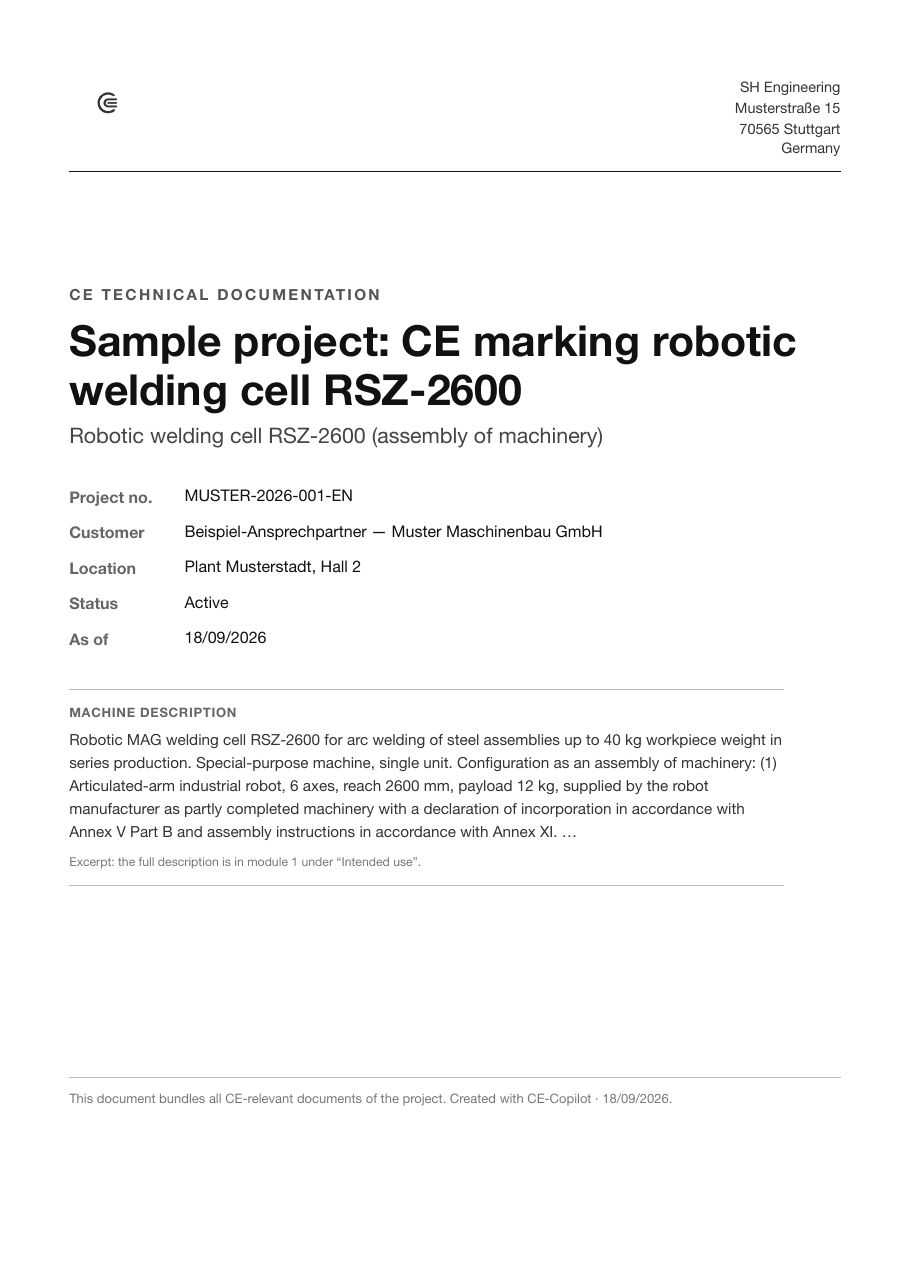
Cover page of the sample dossier: CE technical documentation for the RSZ-2600 robotic welding cell

Sample dossier

CE documentation (technical file)

Stays with the manufacturer and is presented to the market surveillance authority on request.

The internal file: risk assessment per EN ISO 12100, standards applied, EU Declaration of Conformity, technical documentation per Annex IV, test reports, functional safety and cybersecurity. Seven modules in one document.

138 pages · PDF, 1.6 MB · as of 18 September 2026

Seven modules

  • ·Risk assessment (42 hazards)
  • ·Standards applied (24 standards)
  • ·Declaration of Conformity (1 declaration)
  • ·Technical documentation (96 % complete)
  • ·Test reports (64 of 68 test items)
  • ·Functional safety (5 safety functions)
  • ·Cybersecurity (8 of 9 sections fully documented)
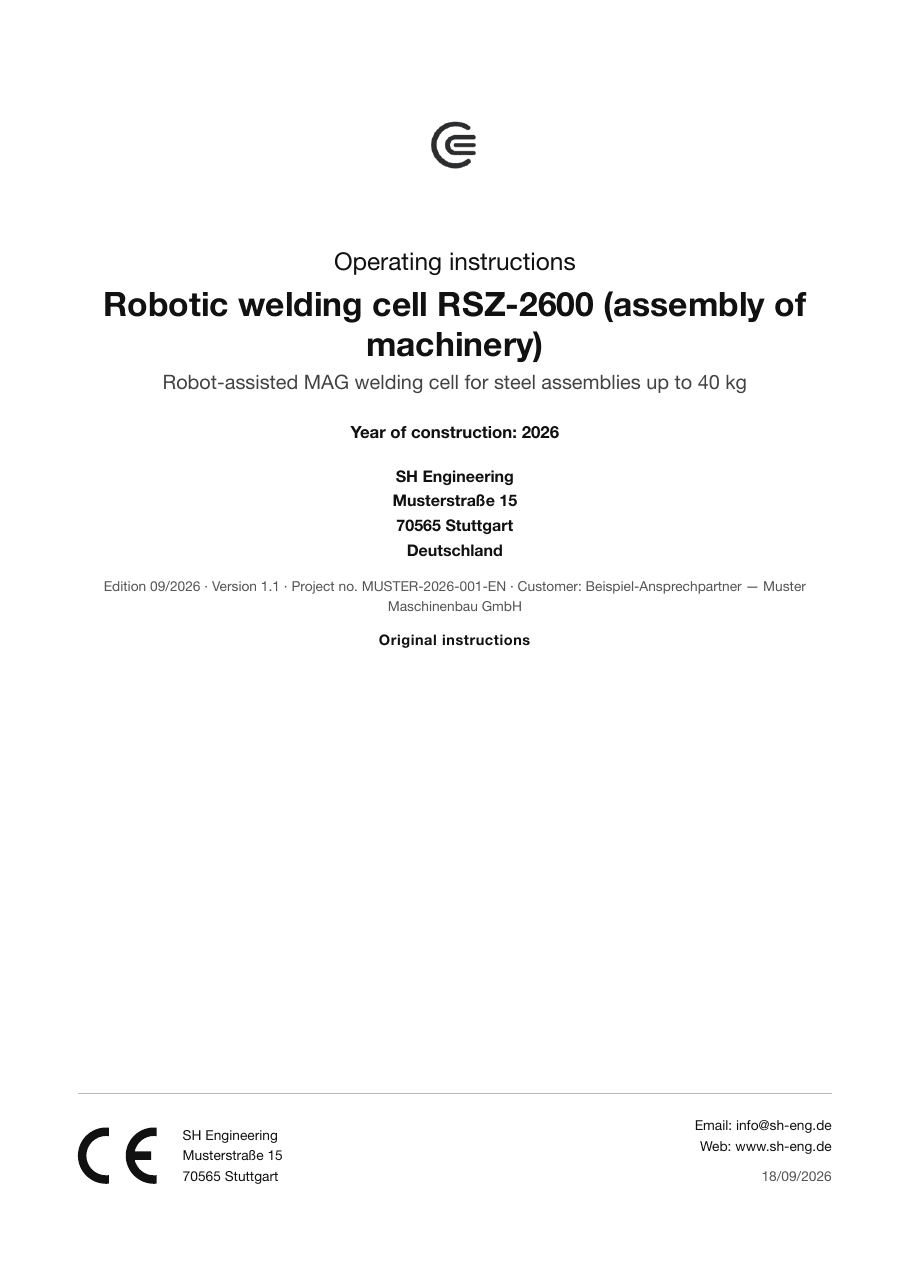
Cover page of the sample operating instructions: RSZ-2600 robotic welding cell with the note 'Original operating instructions'

Sample operating instructions

Operating instructions per Annex III section 1.7.4 of the Machinery Regulation

Goes to the operator together with the machine.

The document for the customer: intended use, protective devices, technical data, installation, operation, maintenance, disposal and cybersecurity. The residual hazards come from the risk assessment of the same project.

113 pages · PDF, 0.8 MB · as of 18 September 2026

Thirteen chapters

  • ·Important basic information
  • ·Safety
  • ·Technical data
  • ·Description of the system
  • ·Delivery, transport, unpacking
  • ·Storage conditions
  • ·Installation site requirements
  • ·Assembly and installation, initial commissioning
  • ·Operation
  • ·Maintenance
  • ·Dismantling and disposal
  • ·Drawings and other information
  • ·Cybersecurity

Why two

Two audiences, two documents.

The technical file is the evidence that the machine was designed safely. It stays with the manufacturer, is kept for ten years and is only presented to the market surveillance authority. The operating instructions, by contrast, are part of the machine: they are delivered with it, must be accessible to operating personnel at all times and must be available in the official language of the country of use.

Both are created in the same project and draw on the same data. The hazards from the risk assessment feed the residual-hazard overview in the operating instructions, and the standards selected appear in both documents. If the assessment changes, the instructions change. That is exactly the difference from two separately maintained Word templates.

What neither document contains: design drawings, circuit diagrams and parts lists. Those are created in CAD and E-CAD; CE-Copilot records and manages them but does not generate them. Nor does either document replace the manufacturer's own technical review and release.

Both examples are published deliberately without any polishing. In the sample dossier, the markers from the standards check appear visibly in the text, because they show the manufacturer where to look. In the operating instructions, named placeholders appear wherever a value can only come from your own design. What has been deliberately left out of each is stated on the document's detail page: Sample dossier · Operating instructions.

124days until EU Machinery Regulation 2027Readiness check

Ready for the new Machinery Regulation?

Move your CE documentation to a guided workflow: from the risk assessment to the Declaration of Conformity, before the Machinery Regulation takes effect on 20 January 2027.

What changes on the cut-over date in concrete terms: for six machinery categories in Annex I Part A of the Machinery Regulation (including removable mechanical transmission devices with their guards, vehicle servicing lifts, cartridge-operated fixing tools and safety-related AI components), self-assessment via harmonised standards is no longer sufficient; there, the notified body becomes mandatory. Check whether your machine is affected

No credit card required · trial with the Starter feature set

The personal demo: 30 minutes, free of charge and without obligation.