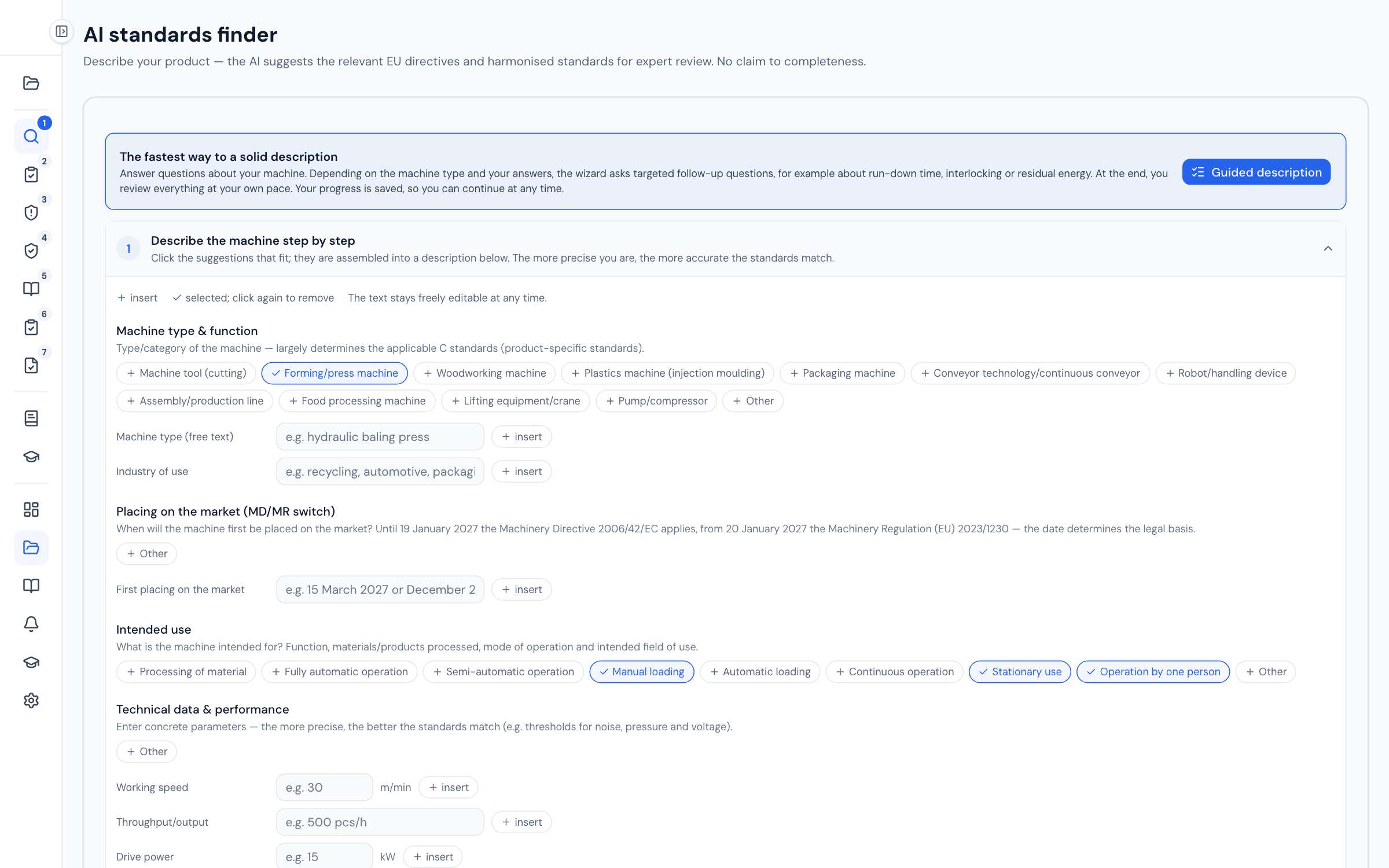
Describe your product. The AI suggests the relevant EU directives and harmonised standards for expert review. No claim to completeness.
The fastest way to a solid description
Answer questions about your machine. Depending on the machine type and your answers, the wizard asks targeted follow-up questions, for example about run-down time, interlocking or residual energy. At the end, you review everything at your own pace. Your progress is saved, so you can continue at any time.
Guided description
2Your description: review and adjust before the analysis
Start AI analysis
Describe the machine step by step
Round 1 of 4 (more will follow from your answers)0 of 31 questions answered
Basics
First, what defines the machine. These details determine the legal basis and the product-specific standards.
What kind of machine is this?
The machine type determines the product-specific C standards, which take precedence over all general standards.
Machine tool (cutting)
Forming/press machine
Woodworking machine
Plastics machine (injection moulding)
Packaging machine
Conveyor technology/continuous conveyor
Robot/handling device
Assembly/production line
Food processing machine
Lifting equipment/crane
Pump/compressor
Machine type (free text)
e.g. hydraulic baling press
Industry of use
e.g. recycling, automotive, packaging
First placing on the market
Until 19 January 2027 the Machinery Directive 2006/42/EC applies; from 20 January 2027 the Machinery Regulation (EU) 2023/1230 applies. This date determines the legal basis.
e.g. 15 March 2027 or December 2026
What is the machine intended for and how is it operated?
The intended use is the starting point of every risk assessment under EN ISO 12100.
Processing of material
Fully automatic operation
Semi-automatic operation
Manual loading
Automatic loading
Continuous operation
Stationary use
Operation by one person
Back
CloseSkip to reviewNext
At the end: your EU Declaration of Conformity.
Every entry comes from the project. You review and sign.
Robotic welding cell RSZ-2600 (assembly of machinery)
Type / Model
RSZ-2600
Serial Number / Range
RSZ2600-2026-0001
Year of Manufacture
2026
We hereby declare under our sole responsibility that the machinery described above is in conformity with all relevant provisions of the Machinery Regulation (EU) 2023/1230. The machinery fulfils the essential health and safety requirements of Annex III of the Machinery Regulation (EU) 2023/1230.
Applied Harmonised Standards
EN ISO 12100:2010
EN ISO 13849-1:2023
EN 60204-1:2018
EN ISO 13857:2019
EN ISO 13855:2024
EN ISO 14120:2015
and 18 more
Conformity assessment procedure
Internal production control (Module A, Annex VI MR)
CE-Copilot is standalone CE marking software by SH Engineering for machinery under the Machinery Directive 2006/42/EC and the Machinery Regulation (EU) 2023/1230, delivered as a web application without installation. Projects, a standards database based on the Official Journal of the EU, risk assessment per EN ISO 12100, the required performance level per EN ISO 13849-1, eleven directive modules, test reports, technical file, operating instructions and the EU Declaration of Conformity sit in one application; the built-in AI makes suggestions in five of the steps. From €119 per month.
Built for exporters to the EU
Manufacturers outside the EU need the same risk assessment, technical file and Declaration of Conformity as EU manufacturers, and from 20 January 2027 under the Machinery Regulation (EU) 2023/1230. The software runs in English; exports such as the Declaration of Conformity are available in English, German, French or Italian.
The CE process in ten steps. In one application, five of them with AI.
CE-Copilot is the CE marking software in which your CE process takes place: from the question of which directives apply at all, to the Declaration of Conformity that you review and sign, and the standards monitoring afterwards. Every step of CE marking under the Machinery Directive 2006/42/EC and the Machinery Regulation (EU) 2023/1230 has its module here, and all modules work on the same project data. The documents are created in one application instead of scattered Excel spreadsheets and Word templates.
10 of 10 process steps covered, 5 of them AI-assisted
One project, one data basis: what you record in the risk assessment is available in the operating instructions, technical file and Declaration of Conformity without retyping.
Standards finder. Describe the machine with building blocks instead of an empty text field; the AI derives the applicable EU directives and harmonised standards from it, each with a justification.
Risk assessment. Hazards with risk figure, life phases and 3-step measures, on request as a complete AI draft; the project standards are linked directly.
Functional safety. PLr per safety function via the risk graph (EN ISO 13849-1), linked to the hazards; the SISTEMA result is recorded for the verification PL ≥ PLr.
Technical file. 50 points per Annex VII of the Machinery Directive or 55 per Annex IV of the Machinery Regulation, with status, notes and encrypted file storage.
Declaration of Conformity. Mandatory-information check per Annex II of the Machinery Directive with live preview; the CE mark is only released once all workflow steps are complete.
Operating instructions. You say what belongs in the instructions; an AI author writes visibly into the document, a curator backs every fact with a source, a reviewer flags what is not substantiated. Missing information becomes questions to you, never guessed values.
The difference from conventional CE software: in five of these steps, an AI (Claude by Anthropic) prepares the draft. It researches directives and standards, suggests hazards and protective measures and drafts chapters of the operating instructions. That takes the searching and writing off your hands, not the decision: AI suggestions are shown before they are applied and can be accepted, changed or discarded; approval stays with you.
01
Determine the legal framework
MD 2006/42/EC · MR (EU) 2023/1230
You describe the machine, the standards finder assigns the applicable EU directives, checks Annex IV of the Machinery Directive or Annex I of the Machinery Regulation (Part A and Part B) and tells you whether a notified body comes into play.
AI-assistedThe AI reads the machine description and derives the applicable directives from it, each with a justification.
What this step requires by lawFirst it must be established which directives and regulations apply to the product at all and whether it falls under the special machinery categories.
The standards database provides status, edition, transition periods and the Official Journal reference. Mandatory standards move into the project checklist with one click, where you record the processing status of each standard.
AI-assistedThe AI selects the relevant standards for your machine from the standards database and marks them as key standards or recommendations. The standards data comes from the Official Journal of the EU, not from the AI; every reference is checked against the database.
What this step requires by lawThe applicable A, B and C standards must be identified and their harmonisation status documented, otherwise the presumption of conformity does not hold.
The guided procedure covers limits, hazard list and evaluation with the 2D risk figure (severity × probability). The AI suggests the typical hazards for each machine type, you decide and correct.
AI-assistedThe AI suggests 12 to 30 typical hazards per machine type across all life phases, including a preliminary evaluation.
What this step requires by lawDetermine the limits of the machine, identify hazards across all life phases, evaluate the risks and document the result in a traceable way.
For each hazard you document the measures in exactly this hierarchy, with an evaluation before and after the reduction. Design and construction happen at the machine; evaluation and evidence happen here.
AI-assistedAt the touch of a button, the AI generates protective measures for all open hazards at once, sorted by the three steps.
What this step requires by lawDefine measures in the order inherently safe design measures, safeguarding and complementary protective measures, information for use, and re-evaluate the remaining residual risk.
You record the safety functions, assign hazards from the risk assessment to them and determine the PLr with the risk graph of EN ISO 13849-1. You calculate the achieved PL in SISTEMA, the free tool of the IFA of the DGUV; you document the result here, the software checks PL against PLr, and a hand-over list makes the SISTEMA entry easier.
What this step requires by lawIf a control-based protective function reduces a risk, such as a light curtain or an interlocked guard door, the required performance level (PLr) must be determined for each safety function and the achieved PL demonstrated.
The test report shows only the tests that match the machine profile. Measured values, result and tester are recorded, and photos can be attached for documentation.
What this step requires by lawSafety functions, electrical equipment, emergency stop, noise and further test points must be tested and the results documented.
A checklist with 50 points under the Machinery Directive or 55 under the Machinery Regulation guides you through the required documents, with status, notes and encrypted file storage. At the end, the full export bundles the project into a PDF or Word file.
What this step requires by lawThe technical documentation must be complete and available to market surveillance authorities on request.
The instructions are created in dialogue across 12 chapters, plus a cybersecurity chapter when the project has a cyber assessment: you give the brief, the text appears visibly in the document. Residual risks and applied standards come from the risk assessment as numbered tables, output as PDF and Word with tables of contents.
AI-assistedAn AI author writes only from the fact sheet, which a curator maintains with sources from the project; a reviewer flags unsubstantiated statements. Missing information becomes questions with answer fields instead of guessed values.
What this step requires by lawOperating instructions must accompany every machine, including residual risks, intended use and reasonably foreseeable misuse.
Add-on module from Professional, one-time purchase per project
Manufacturer, machine and standards data are pre-filled, and a mandatory-field check runs before output. For Annex IV machinery, the procedure selector guides you through the choice of conformity assessment procedure and requires the notified body details as mandatory. The PDF for your review and signature is generated in your layout, in German, English, French or Italian.
What this step requires by lawIssue and sign the Declaration of Conformity with all mandatory information and affix the CE mark to the machine.
Changes to the risk assessment are logged and versioned per hazard; the extended audit trail with history and CSV export is part of the Business plan. The standards tracker notifies you by e-mail of new editions, withdrawals and expiring transition periods for exactly the standards in your projects.
What this step requires by lawThe documents must remain available for ten years, and changes to standards can invalidate the presumption of conformity of ongoing series.
Design, manufacture and the actual implementation of the protective measures on the machine
Calculating the achieved performance level per EN ISO 13849-1 from category, MTTFd, DCavg and CCF: this belongs in SISTEMA (IFA/DGUV, free of charge). Defining the PLr, documenting the result and checking PL ≥ PLr is handled by the functional safety module
Type-examination or a quality assurance system by a notified body, where your machine requires it
Physically affixing the CE mark and the rating plate
Professional review and release: legal responsibility for CE marking remains with the manufacturer
You create the documents for the remaining steps in CE-Copilot and approve them as the expert.
The result
See the finished documents before you start.
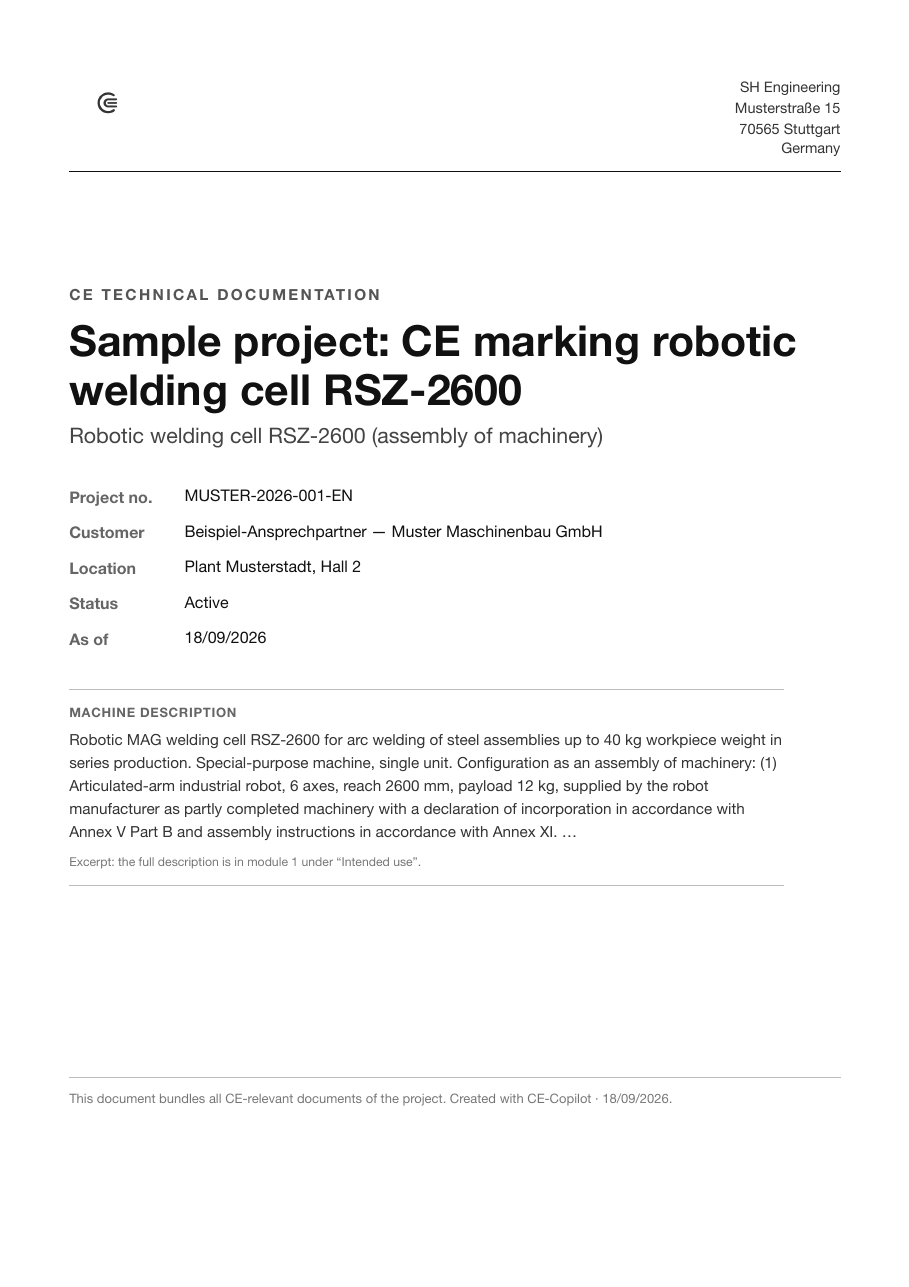
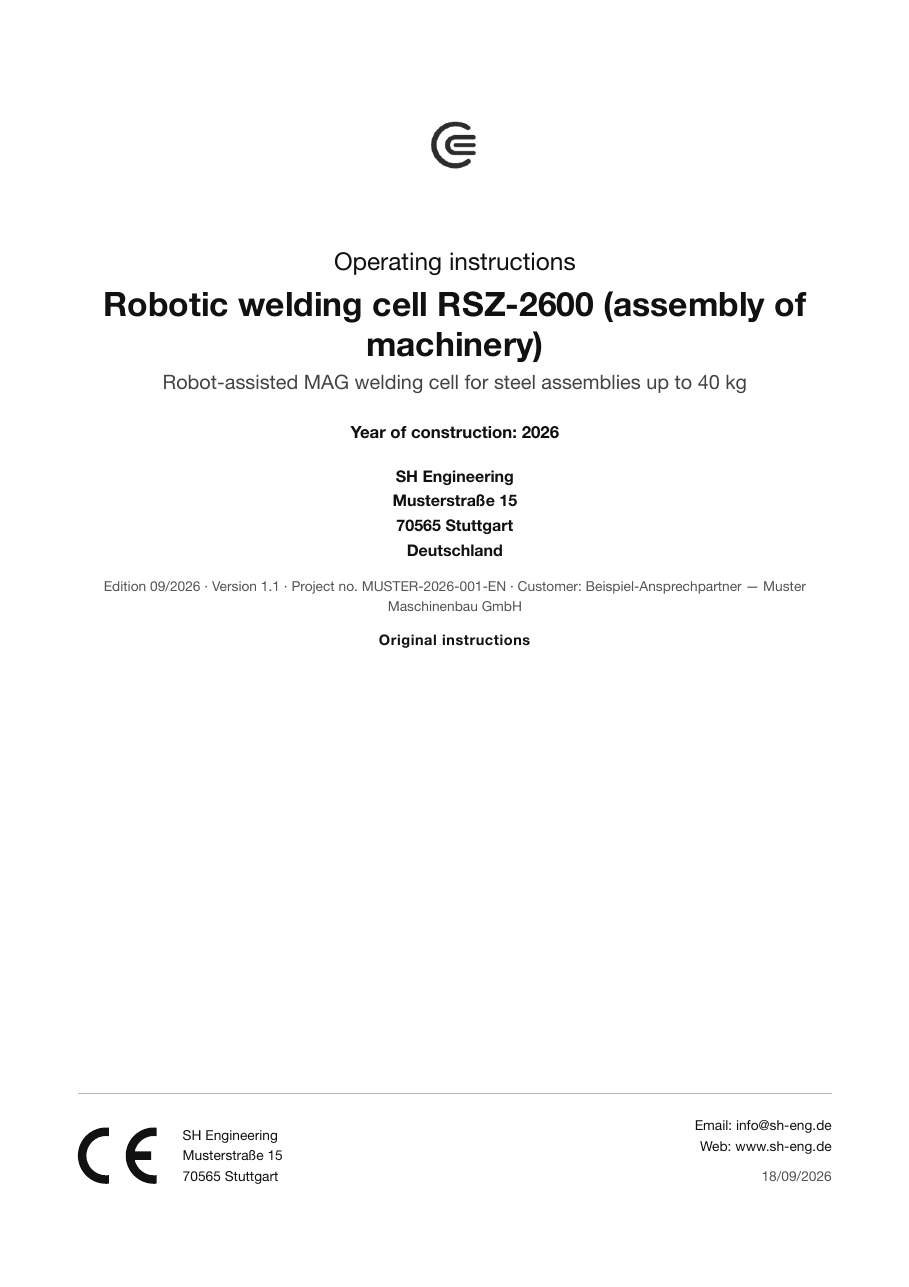
One robotic welding cell, two finished documents: the technical file that stays with the manufacturer, and the operating instructions that ship with the machine. Both exported from the application and published unchanged, both from the same project.
The notified body asks: has EN 12622 been applied in full?
Your hand-fed press brake is Annex IV machinery. Whether you may assess it yourself or must go through EU type-examination depends on whether the harmonised standards have been applied and documented without gaps, point by point, not as a gut feeling.
02
The audit reveals: your control standard is expiring
Your Declaration of Conformity cites EN ISO 13849-1:2015. Its presumption of conformity under the Machinery Directive lasts until 19 January 2027 at the latest; the current edition dates from 2023. Anyone who does not monitor the Official Journal of the EU systematically hears about this from the auditor or from the customer.
03
Delivery in January 2027: Machinery Directive or already Machinery Regulation?
Placing on the market up to 19 January 2027 means the Machinery Directive; from 20 January 2027 the Machinery Regulation applies without exception, with new obligations up to the notified body for Part A categories. This one question of date determines the entire documentation.
From 20 January 2027, the requirements of the EU Machinery Regulation (EU) 2023/1230 apply.
Modules
The modules in detail. For the way you build machines.
Choose your starting point by type of business, or open a module for its scope and use cases. The sequence of all ten steps is shown in the CE process above.
From mechanical engineering. For mechanical engineering.
CE-Copilot is developed by Hünkar Sönmez (SH Engineering), a mechanical engineer, out of practical work with the CE process. Directives, standards and the risk assessment are therefore not bolted onto general-purpose software; they are the core the application is built around.
Mechanical engineer (B.Eng.)
Degree in mechanical engineering and professional experience in industrial automation, close to the manufacturers who place their machines on the market.
Built only for machinery CE
Not a general compliance platform: structure and templates follow the Machinery Directive, the Machinery Regulation, EN ISO 12100 and EN ISO 13849-1.
Developed with its users
Feedback from design engineers, CE officers and technical writers flows into the software on an ongoing basis.
Standards database
3,600+ standards
Of which 2,300+ currently harmonised · reconciled weekly with the Official Journal of the EU
Data protection
No AI training
Your data is not used for AI training; details in the privacy policy
Supporting software, not legal advice
CE-Copilot structures your CE process, checks mandatory fields and generates draft documents for you to review and approve. Legal responsibility for CE marking remains with the manufacturer.
Standards database from the Official Journal of the EUAI suggestions with Claude by AnthropicNo AI training on your data
“The time needed to prepare a risk assessment is cut drastically, and you get good suggestions for hazards and measures.”
(translated from German)
Christian
Mitarbeiter Arbeitsvorbereitung · Kurmann Technik AG
“CE-Copilot presents the tasks in a structured and understandable way. Time savings through AI analysis. Flexible and adaptable to different use cases.”
“The risk assessment suggestions based on the machine described beforehand save a lot of time and speed up the process considerably compared with other software.”
Excerpts from public reviews, translated from the German originals. The full texts, including criticism and suggestions for improvement, are available on OMR Reviews. Names and roles as stated there.
Pricing
Transparent. No hidden costs.
New: three-month licence at the previous monthly price
The previous monthly price (€119 / €229 / €399) now applies to the three-month licence, paid in advance. The monthly plan remains available at €155 / €298 / €519. Existing monthly subscriptions continue unchanged at their previous price.
Starter
The core CE marking steps for individual users
€119
/ month
€357
/ 3 months
Billed in advance for 3 months. Renews for 3 months unless cancelled one month before the end of the term
Save €108 compared with the monthly plan
5 active projects + 25 archived
Functional safety (PLr per EN ISO 13849-1)
Standards tracker (10 standards)
PDF, Word & CSV export
Complete export of the CE documentation as PDF & Word
Multilingual export (DE/EN/FR/IT)
50 AI standards analyses / month
10 risk assessments / month
400 AI measure suggestions / month
10 conformity checks / month
DPA under Art. 28 GDPR, including Anthropic as sub-processor
All prices are final prices · Three-month licence: advance payment for three months, renews for a further three months unless cancelled with one month's notice to the end of the term · Monthly plan cancellable with 14 days' notice to the end of the billing period, annual plan with one month's notice to the end of the term · 14-day free trial (Starter feature set, up to 2 projects) · Discounts compared with the monthly plan: up to 23 % with the three-month licence, up to 36 % with annual payment, up to 39 % on the 3-year plan · 3-year plan (Starter/Professional/Business): advance payment for 36 months with price guarantee, renews for a further 36 months unless cancelled with one month's notice to the end of the term · Payment by credit card or on invoice (bank transfer, payment due within 14 days)
¹ Fair-use quota per month, well above typical demand. Professional / Business: up to 300 / 600 AI analyses, 100 / 150 risk assessments, 1,000 / 1,500 measure suggestions, 300 / 500 conformity checks and 100 / 200 AI extraction sections for import from PDF/Word (Excel import without quota). The quota resets on the 1st of the following month. In addition, a technical upper limit on monthly AI usage applies per account, which normal use does not reach; if it is reached, we unlock after consultation.
Not sure which plan fits?
In 30 minutes we show you CE-Copilot live on your own use case: free and without obligation.
What is CE-Copilot: an AI assistant or standalone CE marking software?
Standalone CE marking software for machinery, running as a web application without installation. All project data is stored in CE-Copilot in structured form and is edited, tracked and output there: project management with templates and archive, a standards database based on the lists of references in the Official Journal of the EU with project checklist and change tracker, risk assessment per EN ISO 12100 with hazards across all life cycle phases, risk estimation before and after the measures and a change history per hazard, hazard templates for 15 machine types, safety signs per ISO 7010, safety functions with the required performance level per EN ISO 13849-1, eleven directive modules (including ATEX, EMC, radio equipment, pressure equipment and the Cyber Resilience Act), test reports with measured values, technical file, operating instructions and the declaration of conformity in Word and PDF, from the Professional plan Safexpert import and export of project data to Excel, and in the Business plan several users with roles and an audit trail. The AI is built into this software: it suggests directives, standards, hazards, protective measures and chapter texts of the operating instructions and checks the declaration of conformity. AI suggestions are shown before they are applied and can be accepted, changed or discarded; approval lies with the manufacturer.
Does CE-Copilot cover the entire CE process or only individual parts?
CE-Copilot covers the ten steps of CE marking for machinery that the CE process on this page describes: determining the legal framework and directives (including the Annex IV check), researching standards and fixing them in the project checklist, carrying out the risk assessment according to EN ISO 12100, documenting protective measures using the 3-step method and evaluating the residual risk, documenting safety functions with the required performance level (PLr) according to EN ISO 13849-1, recording tests and measured values, compiling the technical documentation according to Annex VII of the Machinery Directive or Annex IV of the Machinery Regulation, drawing up the operating instructions according to Annex I section 1.7.4 of the Directive or Annex III section 1.7.4 of the Regulation, issuing the declaration of conformity according to Annex II of the Machinery Directive or Annex V of the Machinery Regulation, and monitoring changes to standards after placing on the market. All modules work on the same project data, you never type anything twice. Outside the software remain design and manufacturing, the calculation of the achieved performance level in SISTEMA, a notified body where required, the physical affixing of the CE marking, and the professional review and release by the manufacturer. So far CE-Copilot produces a list of the applicable essential requirements only for the declaration of incorporation of partly completed machinery.
Can I see in advance what the finished documentation looks like?
Yes. Under “Sample dossier” an example project is available as a PDF: 212 pages of CE documentation for a robot welding cell, exported unchanged from the application. It contains the risk assessment according to EN ISO 12100 with 42 hazards (for each hazard the risk score, protective measures using the 3-step method and the residual risk), the list of the 24 standards applied, the signed declaration of conformity, the overview of the technical documentation according to Annex IV of the Machinery Regulation, 76 of 80 test points in the test reports, 5 safety functions with required and achieved performance level and the cybersecurity chapter under the Cyber Resilience Act. The dossier can be accessed without registration and without an e-mail address. Not included are design drawings, circuit diagrams and parts lists, which come from CAD and E-CAD and are only referenced in the technical documentation. The operating instructions are included as an excerpt of the chapter texts; the complete version with illustrations has its own export.
What changes with the new Machinery Regulation 2027?
The new EU Machinery Regulation (EU) 2023/1230 applies from 20 January 2027 and replaces the EC Machinery Directive 2006/42/EC, with no transition period for placing on the market. Key changes: requirements for cybersecurity and AI systems, digital operating instructions, extended obligations for high-risk machinery (Annex I) and a new structure for conformity assessment. CE-Copilot supports both legal bases: the legal basis you select in the project is decisive, and a notice warns if the date of issue of a declaration does not match the cut-over date.
How does CE-Copilot support the risk assessment under the Machinery Directive?
CE-Copilot guides you through the risk assessment according to EN ISO 12100, for the EC Machinery Directive 2006/42/EC and the new EU Machinery Regulation. The AI suggests typical hazards for each machine type across all life phases, you evaluate with the 2D risk matrix (severity × probability) and document protective measures in the 3-step hierarchy. This does not replace your judgement, but it takes writing and structuring work off your hands.
Is CE-Copilot suitable for series machinery and product lines?
Yes. You create the risk assessment once per machine type and carry it over to every variant or follow-up batch via “Project from template”. Transferred entries are marked “to be reviewed”, so you only confirm the deviations and document nothing twice. The declaration of conformity covers entire serial-number ranges, and the standards tracker reports changes to standards that take effect in the middle of a running series.
Can I create my own assemblies as modules and reuse them in plants?
Yes. You create a hydraulic power unit, a safety fence or a control cabinet once as a project of the type “Module” and assess it there as usual: standards checklist, risk assessment with measures and safety functions. In the Standards Finder of any plant project you tick the module and load it with one click. Standards, hazards and safety functions are copied in with their origin; hazards are marked “to be reviewed”, safety functions start with verification open, and the plant description lists the module. Twelve typical modules come as templates. You assess the interfaces between the modules in the plant project, because conformity applies to the assembly as a whole.
Which standards are included in the database?
Over 3,600 standards, of which over 2,300 are currently harmonised (as of September 2026), from twelve OJEU lists: Machinery Directive 2006/42/EC (851 actively harmonised standards), Low Voltage 2014/35/EU (576), EMC 2014/30/EU (130), ATEX 2014/34/EU (93), Pressure Equipment 2014/68/EU (203), Radio Equipment 2014/53/EU (189), Lifts 2014/33/EU (15), PPE (EU) 2016/425 (201), General Product Safety (EU) 2023/988 (73), Gas Appliances (EU) 2016/426 (21), Simple Pressure Vessels 2014/29/EU and RoHS 2011/65/EU. The list for the new Machinery Regulation 2023/1230 is prepared in the system; its first list of standards will be adopted after review as soon as the EU publishes it. Withdrawn editions also remain on record. That matters for existing machinery and for the standards tracker. In addition there are practice-relevant DACH rules and regulations (DGUV, DIN VDE, TRBS) without presumption of conformity, clearly labelled. Weekly automatic comparison with the European Commission's lists of references; decisions already published in the Official Journal but not yet in those lists are added with their official source.
Does the AI invent the standards, or do they come from a database?
From a database. The standards are not AI-generated: they are held in a maintained database whose source is the Official Journal of the EU (OJEU), that is, the official lists of harmonised standards. This database is compared automatically with the Official Journal every week. The AI invents no standard numbers, it selects from this existing stock the standards that match your machine and prioritises them. Afterwards every suggested standard is checked against the database: number, title, standard type (A/B/C) and harmonisation status come from the database and overwrite the AI output. If a number cannot be verified against the database, it is marked “to be reviewed” instead of being presented as a valid standard. In this way CE-Copilot combines a reliable standards database with an AI that only speeds up the selection.
Does CE-Copilot support functional safety according to EN ISO 13849-1?
Yes, with a clear division of labour. In the Functional Safety module (from the Starter plan) you record your safety functions, assign hazards from the risk assessment to them and determine the required performance level (PLr) with the risk graph of EN ISO 13849-1 from severity of injury, frequency and possibility of avoidance. The calculation of the performance level actually achieved from category, MTTFd, DCavg and CCF is carried out in SISTEMA, the free tool of the IFA of the DGUV; a CSV hand-over list makes the entry there easier. You then document the SISTEMA result in the module, the software checks PL against PLr and points out contradictions with the characteristic values of the standard. CE-Copilot replaces neither SISTEMA nor the validation according to EN ISO 13849-2.
What does the EU AI Act mean for CE marking?
Since the Digital Omnibus (EU) 2026/1744, the Machinery Regulation (EU) 2023/1230 is listed in Annex I Section B of the AI Act (EU) 2024/1689. For high-risk AI systems in machinery, such as an AI system acting as a safety component, only Article 6(1), Article 60a and Articles 102 to 112 of the AI Act therefore apply (Article 2(2) AI Act). The substantive requirements for such AI systems come through the Machinery Regulation: under Article 8 of the Machinery Regulation the Commission adds them to Annex III by delegated acts that apply from 2 August 2028. For an AI system acting as a safety component, no separate conformity assessment under the AI Act is therefore added. It is different for AI systems under Annex III of the AI Act, for example for evaluating the performance or behaviour of workers: from 2 December 2027 the full Chapter III applies to them, with their own conformity assessment, declaration, CE marking and registration (Articles 43, 47 to 49 AI Act). AI-related risks belong in the risk assessment in any case. CE-Copilot helps you assess whether your machine is affected.
Do I also get the full texts of the standards?
No: full texts of standards are protected by copyright, are licensed by the publishers (e.g. DIN Media) and are not included in any provider's subscription. CE-Copilot gives you the metadata that matters for CE marking: harmonisation status, edition, transition periods, Official Journal references and the assignment to your machine. That way you know which standards you really need to buy before you spend any money.
Can I store the standards I have purchased in CE-Copilot?
Yes, from the Professional plan: under “My standards documents” you store full texts of standards you have licensed yourself as PDFs and manage them centrally in your account, instead of searching for them in e-mail attachments and local folders. The files remain private to your account and do not flow into the public standards database. CE-Copilot itself provides no full texts of standards and does not evaluate the stored files with AI. The usage rights remain with you: you store only standards for which you hold a valid licence, and you clarify the licensing conditions for cloud storage (for example under your publisher licence) with your standards supplier.
Which exports are available?
The four core documents (risk assessment, declaration of conformity, standards analysis, technical documentation) export individually as PDF and Word, plus CSV for tables. In addition, the complete export bundles a project into one file, as PDF or Word, with cover sheet, logo, risk assessment, applied standards, declaration of conformity, technical documentation, test reports and, where recorded, the safety functions with PLr and SISTEMA result. The declaration of conformity is available in several languages (DE/EN/FR/IT).
Does CE-Copilot replace a CE consultant?
CE-Copilot replaces the tools, not the professional judgement. The documentation from directive classification to the declaration of conformity is created in one application instead of scattered Excel spreadsheets and Word templates. The legal responsibility for CE marking, however, lies with the manufacturer, and critical decisions belong in the hands of qualified specialists. The difference from before: your expertise goes into decisions instead of formatting, research and writing.
Where is my data stored?
The database runs on Supabase. The AI analysis is carried out via the Claude API from Anthropic; your data is not used for training there. The details are set out in the privacy policy.
Can I import data from Safexpert?
Yes. CE-Copilot imports existing Safexpert projects via the Excel data export (data export of the risk assessment in tabular form): upload the file, check the recognised columns and the preview, import. Hazards, measures (3-step method), hazard zones, life phases and standard references end up in the right places; the risk evaluation is transferred to the 2D matrix in a documented way, and every transferred item remains marked “Imported, to be reviewed” until you have confirmed it professionally. In the other direction you export projects in structured form as Excel or JSON. Available from the Professional plan.
Must operating instructions accompany every machine?
Yes. Annex I section 1.7.4 of the Machinery Directive 2006/42/EC requires operating instructions for every machine, as original instructions or as a translation of them into the official languages of the country of use. They are at the same time the third step of risk reduction according to EN ISO 12100: whatever cannot be eliminated by design and technical measures must be addressed through information for use. These content requirements remain essentially in place under the Machinery Regulation (EU) 2023/1230 from 20 January 2027.
What must operating instructions for machinery contain?
According to Annex I section 1.7.4 of the Machinery Directive they must include, among other things: details of the manufacturer and the machine, intended use and reasonably foreseeable misuse, technical data, transport and assembly, installation and commissioning, operation, maintenance, troubleshooting, dismantling and the remaining residual hazards with protective measures. CE-Copilot maps this as a 12-chapter structure and pre-fills it from your project data; residual hazards and applied standards are taken automatically from the risk assessment at export.
Can CE-Copilot also create the operating instructions?
Yes, as an add-on module from the Professional plan (one-time purchase per project, no recurring fee). A guided editor leads through 12 chapters according to Annex I section 1.7.4 of the Machinery Directive; use, limits, interfaces and measured values are pre-filled from the project data, residual hazards and applied standards are taken automatically from the risk assessment at export. On request the AI formulates chapters as a reviewable draft, missing details appear as placeholders instead of guessed values. Export as PDF and Word; the professional review remains with the manufacturer.
Is there a free trial?
Yes. 14 days free of charge with the feature set of the Starter plan and up to 2 projects (deleted ones count), including standards finder, risk assessment and conformity assessment. No credit card required. In the interactive demo you see the standards finder with prepared results, without registration.
How flexible are the contracts, and is VAT added on top?
The three-month licence is paid in advance for three months at a time; it renews for a further three months unless cancelled with one month's notice to the end of the term. Monthly and annual plans can be cancelled: the monthly plan with 14 days' notice to the end of the billing period, the annual plan with one month's notice to the end of the term. There is no compulsory annual subscription (compared with the monthly plan, the three-month licence is up to 23% cheaper and annual payment up to 36% cheaper). If you want planning certainty, choose the 3-year plan for Starter, Professional or Business: an advance payment for 36 months with a price guarantee, which renews for a further 36 months unless cancelled with one month's notice to the end of the term. The prices shown are final prices, so nothing is added on top.
From the directive check to the Declaration of Conformity in one application, under the Machinery Directive today and under the Machinery Regulation from 20 January 2027.
What changes on the cut-over date in concrete terms: for six machinery categories in Annex I Part A of the Machinery Regulation (including removable mechanical transmission devices with their guards, vehicle servicing lifts, cartridge-operated fixing tools and safety-related AI components), self-assessment via harmonised standards is no longer sufficient; there, the notified body becomes mandatory. Check whether your machine is affected