Cover page
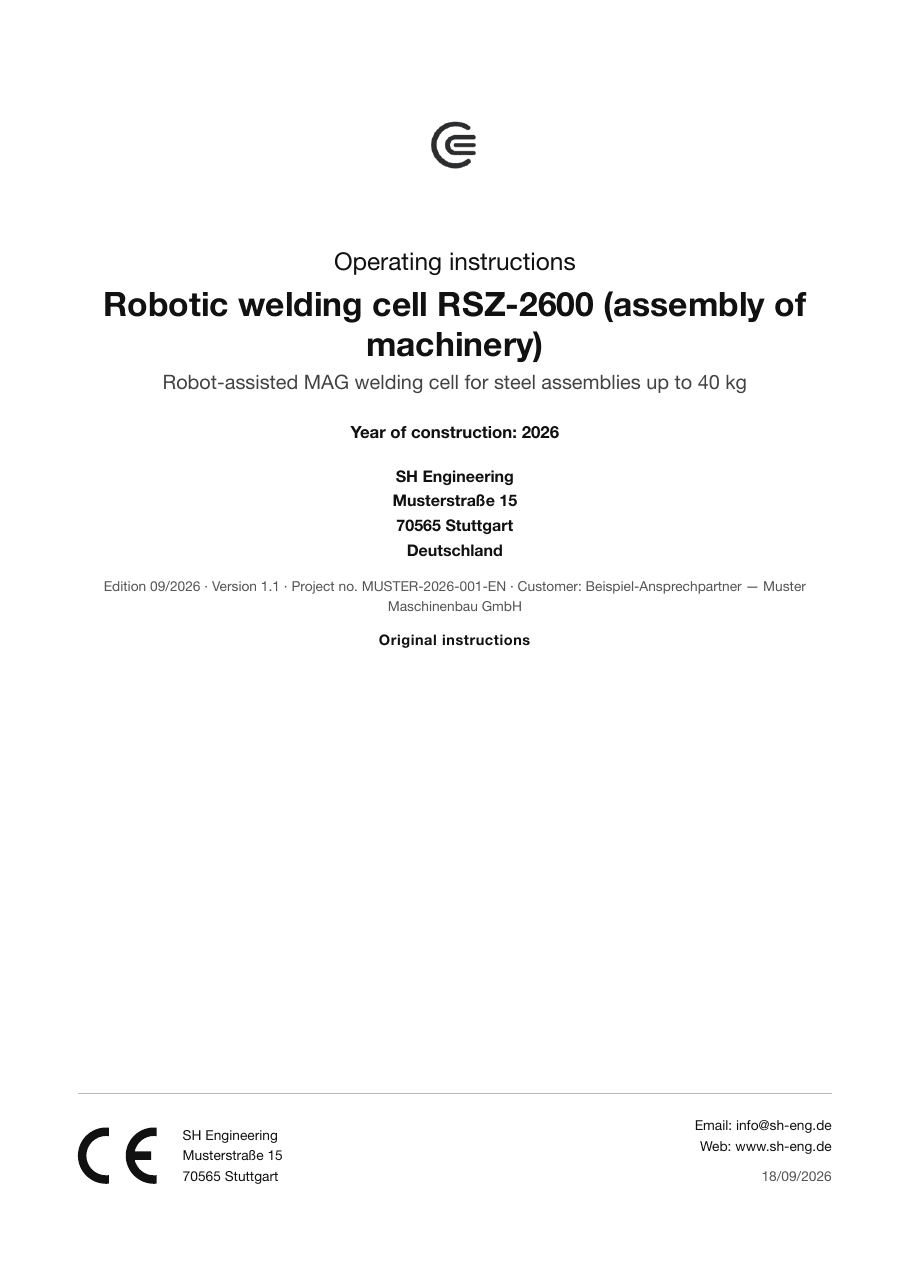
Machine designation, year of construction, manufacturer, edition and version, plus the note 'Original operating instructions' per Annex III section 1.7.4.1 of the Machinery Regulation. Logo and contact details come from your account.
Sample operating instructions
113 pages, exported from CE-Copilot and published unchanged. The example is the RSZ-2600 robotic welding cell, a special-purpose machine forming an assembly of machinery, structured in thirteen chapters per Annex III section 1.7.4 of the Machinery Regulation, from intended use to disposal. The residual hazards come from the risk assessment of the same project.
This is the English edition of the operating instructions, exported from the English edition of the platform. The same project exists in German, and the Declaration of Conformity can also be exported in French and Italian.
No sign-up, no email address required · PDF, 0.8 MB · as of 18 September 2026
Not copied from a template
The difference from a Word template is not the layout but these sections: they are generated on export from the other modules of the same project and carry a source note in the document. If the risk assessment changes, the instructions change.
42 hazards
From the project's risk assessment, structured by life phase, with the protective measures for each hazard. Appears in the Safety chapter.
24 standards
From the project's standards checklist, separated into type A, B and C standards, with title and the directive under which they are harmonised.
by life phase
Tabular record with risk number and acceptance decision per hazard, plus the list of annexes of the applicable documents.
Pages from the document
Machine designation, year of construction, manufacturer, edition and version, plus the note 'Original operating instructions' per Annex III section 1.7.4.1 of the Machinery Regulation. Logo and contact details come from your account.
Guards and non-contact protective devices, safety functions with performance level and category, emergency stop, operating mode selection and energy isolation.
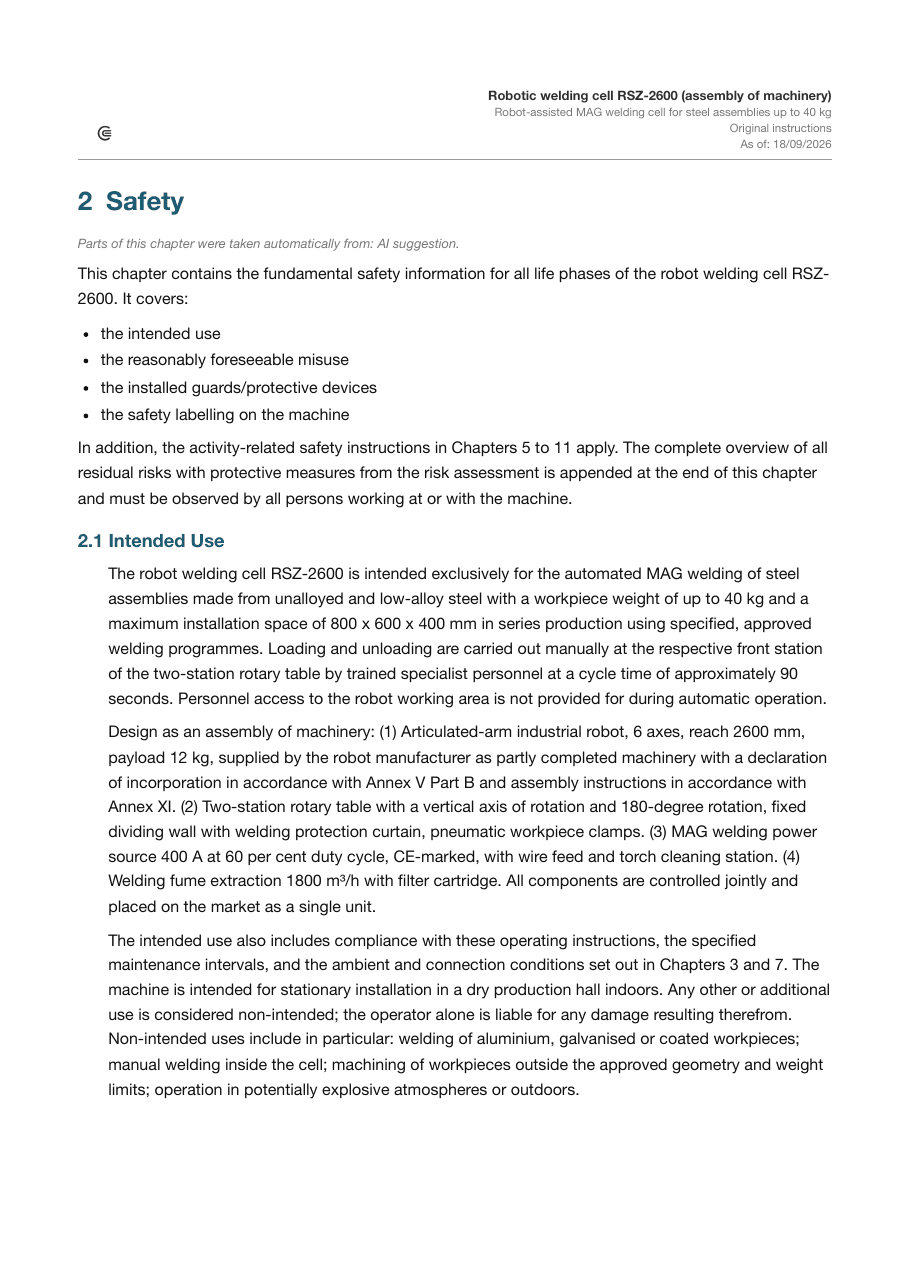
Each hazard with its life phases and the associated protective measures. This part is taken automatically from the project's risk assessment on export, with a source note.
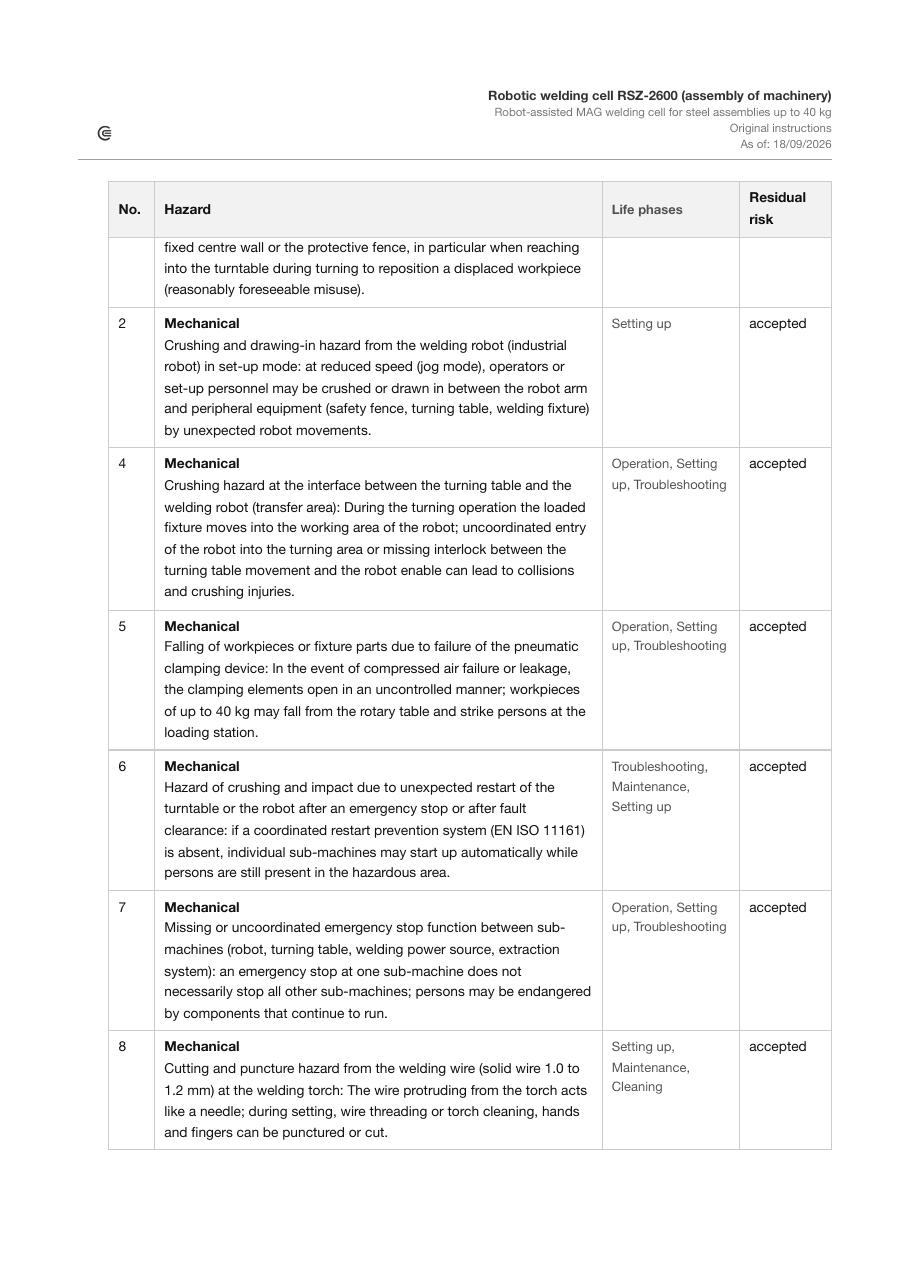
Dimensions and weights, electrical equipment, process data and noise emission with measurement method and measurement uncertainty.
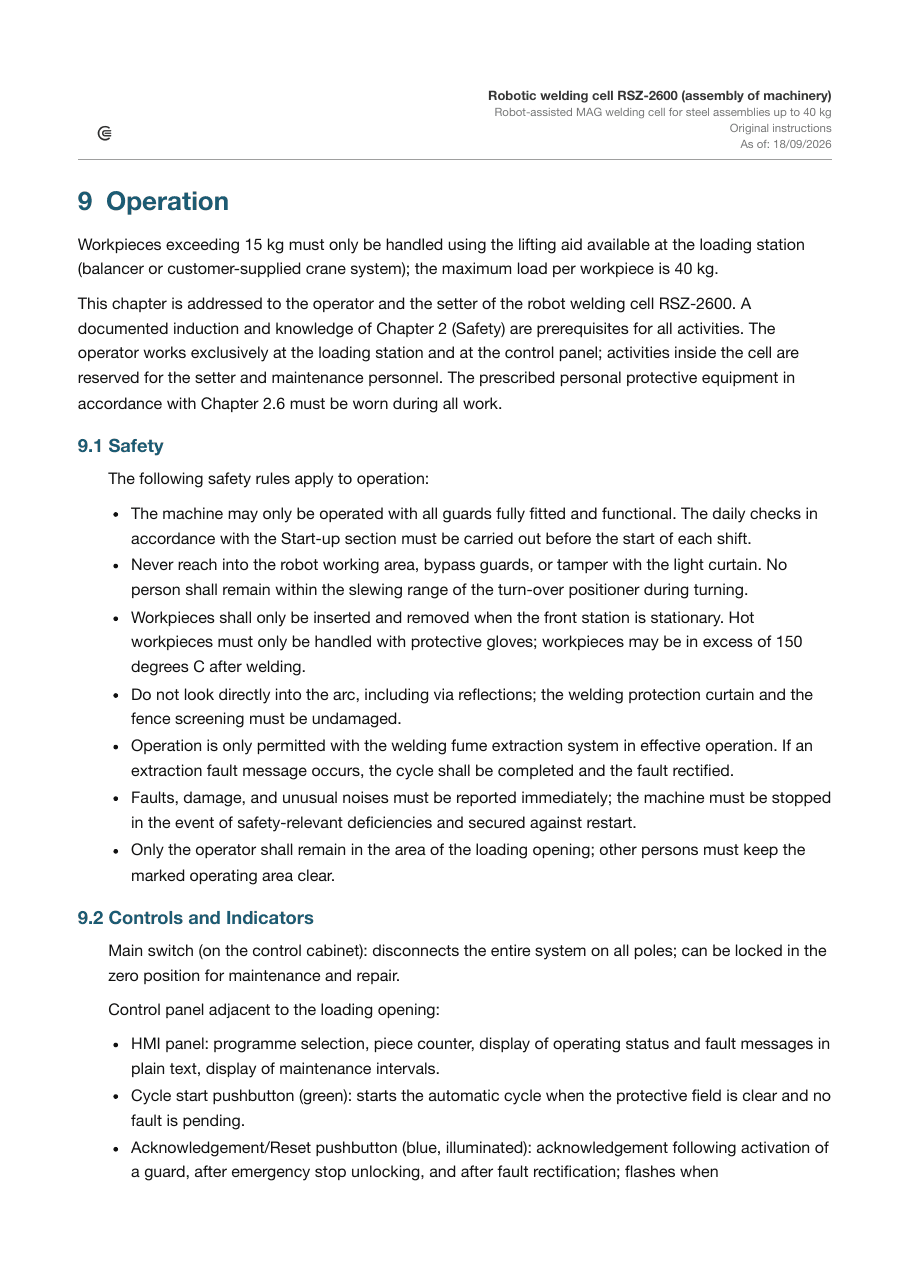
Controls and indicators, operating modes with their safety conditions, start-up, set-up and shutdown.
Structure
The structure follows Annex III section 1.7.4 of the Machinery Regulation and can be freely adapted in the editor: rename, move or hide chapters, or add your own. The numbering in the document follows suit.
Scope of delivery and limits of the machine, division of responsibility between system builder and operator, external interfaces, legal notes and the list of harmonised standards applied.
Intended use, reasonably foreseeable misuse, safety signage, protective devices with safety functions and performance level. Followed by the complete overview of residual hazards from the risk assessment, structured by life phase.
Dimensions, weights, connection values, workpiece data and ambient conditions. Noise emission is stated with measurement method and measurement uncertainty where Annex III section 1.7.4.2 requires it.
Structure and main assemblies, operator workstations and the sequence of an automatic cycle.
Safety instructions for handling, weights and centres of gravity, lifting points, transport locks and unpacking.
Permissible storage environment, corrosion protection and maximum storage period with recurring inspections.
Space requirements, foundation and load-bearing capacity, ambient conditions including the intended electromagnetic environment, and the on-site supply connections.
Safety rules for assembly, the assembly and installation steps and the documented initial commissioning.
Controls and indicators, operating modes, start-up and set-up, and safe shutdown in normal operation and after an emergency stop.
Maintenance record, inspection and maintenance schedule with intervals and tasks, lubrication schedule and the fault table for troubleshooting.
Safe dismantling, separation and disposal of operating fluids, material separation and recycling.
Drawings and spare parts, electrical documentation, plus the record of the risk assessment by life phase and the list of annexes.
Integration into the operator's network, checking the software version and evidence of interventions, remote maintenance, installing updates with a subsequent functional test, retaining the logs, the table of digital interfaces and the user information per Annex II of the Cyber Resilience Act.
Limits
Context
The technical documentation stays with the manufacturer and is presented to the market surveillance authority on request. The operating instructions go to the operator together with the machine. That is why there are two exports for two audiences: the sample dossier shows the internal file over 140 pages, this example shows the document for the customer.
In the product: The operating instructions are an add-on module in the Professional plan and are unlocked once per project for €12.99. The assistant pre-fills the chapters from the project data, adds AI text suggestions on request and exports to PDF and Word. Every text remains editable. Since September 2026 the instructions are created in dialogue with an author, a curator and a reviewer, described in the guide Operating instructions in dialogue.
Move your CE documentation to a guided workflow: from the risk assessment to the Declaration of Conformity, before the Machinery Regulation takes effect on 20 January 2027.
What changes on the cut-over date in concrete terms: for six machinery categories in Annex I Part A of the Machinery Regulation (including removable mechanical transmission devices with their guards, vehicle servicing lifts, cartridge-operated fixing tools and safety-related AI components), self-assessment via harmonised standards is no longer sufficient; there, the notified body becomes mandatory. Check whether your machine is affected
No credit card required · trial with the Starter feature set
The personal demo: 30 minutes, free of charge and without obligation.